
Mediterranean Diet: What the Evidence Actually Supports
Mediterranean-style eating is often promoted as though it were a precise menu with near-universal health benefits. The Mediterranean diet evidence is more specific and more useful than that: it supports a flexible, plant-forward eating pattern, with the strongest clinical findings relating to cardiovascular outcomes in people at elevated risk. It does not establish a cure, guarantee weight loss or prove that one ingredient is responsible for the results.
The details matter. Major trials provided recurring dietary education, and some supplied olive oil or nuts. Participants were mainly older adults in Spain with high cardiovascular risk or established coronary disease. The findings are meaningful, but they should not be stretched into a claim that every person needs the same foods or that this pattern is superior to every other well-supported way of eating.
What “Mediterranean diet” means in research
There is no single, universally standardized Mediterranean diet. The term describes a family of dietary patterns, and researchers have used different definitions, adherence scores and intervention protocols. This variation reflects both the diversity of food traditions around the Mediterranean and differences in how studies translate those traditions into research instructions.
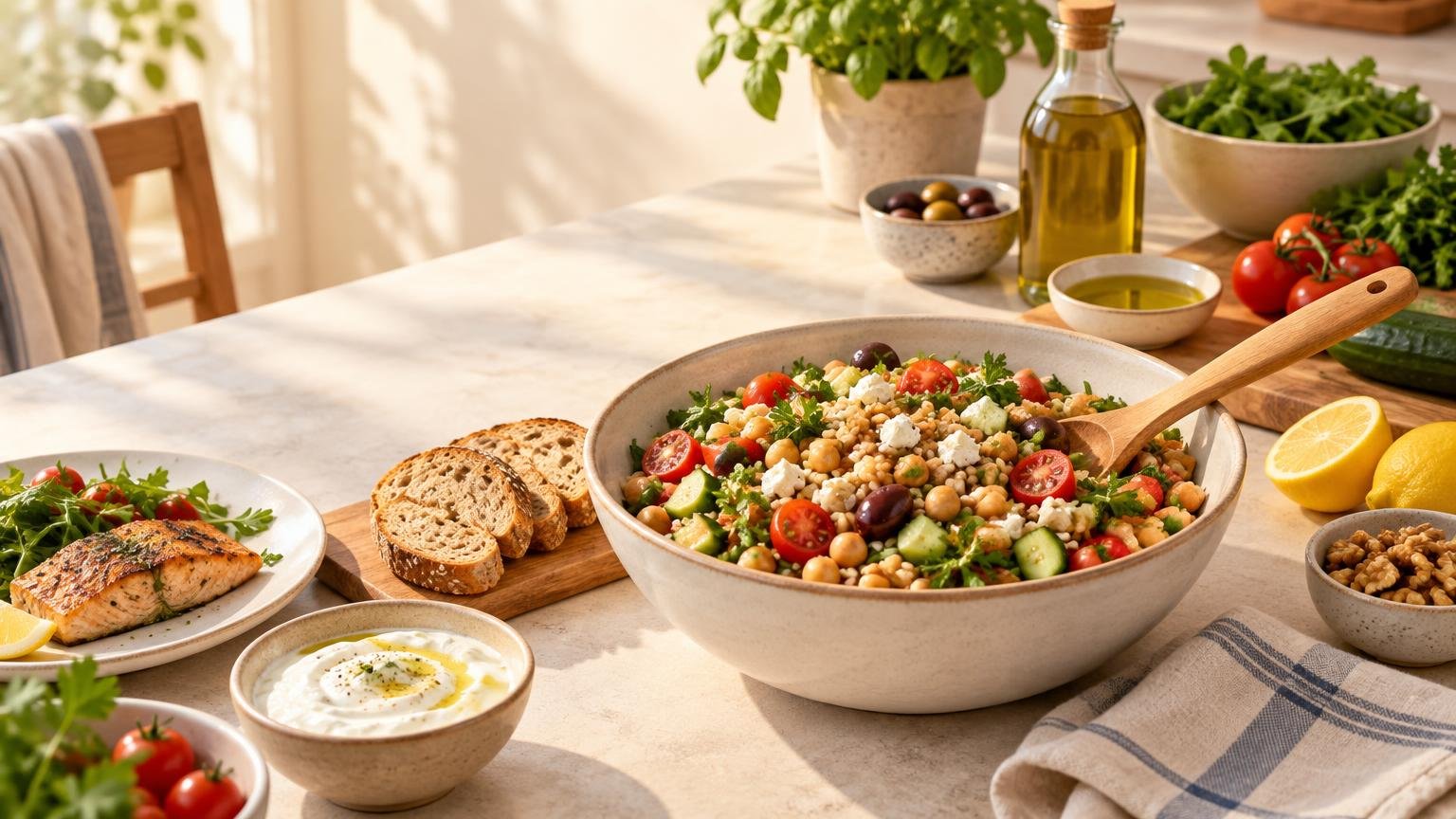
Common versions emphasize vegetables, fruit, legumes, whole grains, nuts and unsaturated fats, often with olive oil as a principal added fat. Fish may be included regularly, while red and processed meats, sweets and highly refined foods are generally less prominent. Exact amounts, food choices and macronutrient proportions differ. A Mediterranean-style pattern can therefore be adapted to local staples rather than reconstructed from imported products.
It is also a whole dietary pattern, not an olive-oil, nut or fish intervention in isolation. When a trial changes several foods at once, it cannot show that one “superfood” caused the result. Possible benefits may reflect food substitutions, the combination of nutrients and the ability to maintain the pattern over time.
How strong is the Mediterranean diet evidence?
The most persuasive evidence comes from randomized trials that measured major cardiovascular events rather than relying only on cholesterol, blood pressure or other risk markers. Two influential Spanish trials, PREDIMED and CORDIOPREV, provide much of this support. Their findings are important, but their populations and intervention designs define how far the conclusions can travel.
What PREDIMED actually tested
PREDIMED enrolled 7,447 adults aged 55 to 80 who had high cardiovascular risk but no cardiovascular disease at enrollment. Participants were assigned to an energy-unrestricted Mediterranean diet supplemented with extra-virgin olive oil, a Mediterranean diet supplemented with nuts, or advice to reduce dietary fat. The interventions included recurring education, and the corresponding supplemental foods were provided to the two Mediterranean groups.
Over a median follow-up of 4.8 years, both Mediterranean groups experienced fewer events in the composite cardiovascular outcome than the control group. This is stronger evidence than a study measuring only short-term changes in a laboratory marker. It indicates that the supported intervention can affect meaningful clinical events in a high-risk population.
It does not show that handing someone a Mediterranean food list once will reproduce the result. The trial combined dietary advice, continued support and supplied foods. Nor does it isolate the effect of olive oil, nuts or any other single component.
PREDIMED also requires an important methodological qualification. The original report was retracted and republished in 2018 after departures from the intended randomization procedures were identified. The republished analysis continued to report lower cardiovascular-event rates in the intervention groups, but the correction is relevant when judging the trial’s certainty. It is a reason for careful interpretation, not a reason to pretend the study never happened.
What CORDIOPREV adds
CORDIOPREV studied a different clinical situation: 1,002 people who already had coronary heart disease. In this randomized, single-center Spanish trial, participants followed either a Mediterranean or low-fat diet and were observed for seven years. Major cardiovascular events occurred less often in the Mediterranean-diet group.
The trial strengthens the case that the pattern can matter beyond risk-marker changes, including in secondary prevention. However, it was conducted at one center, and its participants were predominantly male. Its findings should not automatically be assumed to apply equally across sex, age, cultural setting and health status.
Systematic reviews make the conclusion more cautious
Individual trials can attract more attention than broader evidence reviews, especially when their results are positive. A 2020 Cochrane review of Mediterranean-style diets and cardiovascular prevention included 30 randomized trials. It found moderate-certainty evidence for fewer strokes in primary prevention, but judged much of the wider clinical-outcome evidence—and the secondary-prevention evidence available at that time—to be limited or lower certainty.
That conclusion is not necessarily inconsistent with PREDIMED or the later CORDIOPREV findings. Reviews assess the entire evidence base, including differences in diet definitions, comparators, study quality, follow-up and outcome reporting. A few substantial trials can point toward benefit while the broader literature remains uneven.
The most defensible summary is that Mediterranean-style interventions have meaningful evidence for cardiovascular prevention, especially among people with elevated risk, but the strength is not identical for every cardiovascular outcome or population. Evidence about events such as heart attack and stroke should also be kept separate from evidence about intermediate markers such as triglycerides or waist circumference.
Is it a weight-loss diet?
Mediterranean-style eating may be used within a weight-management plan, but weight loss is not guaranteed and is not what defines the pattern. It can be energy-restricted or energy-unrestricted. PREDIMED, for example, tested energy-unrestricted interventions rather than a conventional calorie-controlled weight-loss program.
A 2025 systematic review and meta-analysis examined 26 randomized trials involving adults with overweight or obesity. Compared with other diets or dietary advice, Mediterranean diets produced small average reductions in body mass index, waist circumference, triglycerides and fatty-liver index. Several other risk factors did not change significantly, and reviewers rated most of the outcome evidence as low or very low certainty.
Those findings support modest expectations. An eating pattern may improve food quality or some risk factors without producing a large change in body weight. Individual responses also differ, and short-term changes in weight or waist circumference are not interchangeable with proof of fewer cardiovascular events.
Foods such as nuts and olive oil are nutrient-dense but also energy-dense. They do not need to be avoided, yet simply adding them on top of an existing diet is different from using them to replace other foods. For readers interested in meal satisfaction, the balance among legumes, vegetables, whole grains and other fiber-rich foods in real meals may be more practical than focusing on a single signature ingredient.
What the research does not establish
- It does not prove that Mediterranean-style eating prevents every disease associated with it in headlines or observational research.
- It does not establish one official menu, required macronutrient ratio or perfect adherence score.
- It does not show that olive oil, nuts, fish or any other single food explains the cardiovascular findings.
- It does not demonstrate superiority over every well-designed dietary pattern. Comparator diets, the quality of support and actual adherence all affect the result.
- It does not promise a particular amount of weight loss or guarantee that body weight will change.
- It does not require alcohol. People who do not drink should not begin for health reasons.
Adherence depends on more than motivation
A dietary pattern works in daily life only if it fits a person’s budget, food access, schedule, culture, cooking facilities, taste and household needs. A systematic review of observational and qualitative research identified financial, cultural, access, time, taste, lifestyle, knowledge and motivational factors as barriers or facilitators to adopting a Mediterranean-style diet.
This matters because trial participants may receive more education and support than someone following advice independently. PREDIMED also supplied olive oil or nuts, reducing part of the cost and access burden. Results from a supported intervention should not be interpreted as evidence that adherence is merely a matter of willpower.
American Heart Association guidance similarly emphasizes the overall dietary pattern and recognizes that real-world factors can affect whether heart-supportive eating is feasible. A culturally familiar pattern built around affordable local foods may be more sustainable than one that depends on expensive fish, specialty oil or unfamiliar recipes.
Practical ways to adapt the pattern
Following the evidence-informed core does not require an all-or-nothing conversion. A reader can choose one or two substitutions that fit existing meals and evaluate whether they are affordable and enjoyable. Examples include:
- Use beans, lentils or chickpeas in some meals where meat would otherwise be the main ingredient.
- Add frozen or canned vegetables when fresh produce is expensive, unavailable or likely to spoil. Products with less added sodium may be useful where available, and rinsing canned foods can suit some meals.
- Choose a familiar whole-grain staple when practical rather than buying specialty Mediterranean products.
- Use an unsaturated oil in place of a fat higher in saturated fat where the flavor, cooking method and budget allow.
- Choose nuts or seeds in portions that work for the meal, with alternatives for anyone who has an allergy.
- Use canned fish where suitable, while recognizing that a Mediterranean-style pattern can still be plant-forward when fish is unavailable, unaffordable or culturally unsuitable.
- Build meals from familiar flavors. The useful principles can be applied through many cuisines rather than forcing every dish to resemble food from southern Europe.
People increasing legumes, whole grains and vegetables substantially may find a gradual change more comfortable than an abrupt jump in fiber. The goal is a workable pattern, not a perfect score. If cost is the main constraint, dried or canned legumes, seasonal produce, frozen vegetables and store-brand staples may deliver the pattern’s basic structure without premium ingredients.
When individualized guidance matters
General evidence cannot account for every medical condition, medication or nutrition requirement. People taking warfarin should keep vitamin K intake consistent because sudden dietary changes can alter the medicine’s anticoagulant effect. That does not mean avoiding vegetables; it means discussing major changes with the clinician managing the medication rather than changing intake unpredictably.
Individual guidance may also be appropriate for people with kidney disease, significant gastrointestinal disease, food allergies, an eating-disorder history, pregnancy-related needs, or diabetes treated with medication. The relevant issue is not that Mediterranean-style eating is inherently dangerous. It is that changes in carbohydrate, potassium, vitamin K, fiber or overall intake can have different implications when a condition or treatment imposes specific requirements.
Children and adolescents also have growth and developmental needs that a general adult evidence review cannot address. A registered dietitian or qualified clinician can help adapt the broad pattern without turning it into unnecessary restriction or conflicting with prescribed care.
A reasonable interpretation of the evidence
Mediterranean-style eating is one of the better-supported dietary patterns for cardiovascular health, particularly in the high-risk populations studied in its major trials. The evidence is strongest when the intervention is understood as a supported, sustained pattern—not as a bottle of olive oil, a handful of nuts or a rigid “Mediterranean” meal plan.
A practical next step is to examine meals already eaten regularly and identify one feasible substitution: more legumes, an additional vegetable, a whole-grain staple or an unsaturated fat replacing another fat. That approach respects what the trials suggest while leaving room for culture, cost, access and personal preference. Consistency with a workable pattern is more useful than chasing perfect adherence to a diet that has never had one universal definition.
Frequently Asked Questions
Is there one official Mediterranean diet?
No. Research uses different definitions, adherence scores and protocols. The shared emphasis is generally a plant-forward dietary pattern rather than one standardized menu.
What did PREDIMED actually test?
PREDIMED compared two energy-unrestricted Mediterranean interventions—one supplemented with extra-virgin olive oil and one with nuts—with advice to reduce dietary fat. Participants received recurring education, and the supplemental foods were provided.
Why does the PREDIMED republication matter?
The original report was retracted and republished in 2018 after departures from intended randomization procedures were identified. The revised analysis still reported fewer cardiovascular events in the intervention groups, but the correction warrants careful interpretation.
Is Mediterranean-style eating guaranteed to cause weight loss?
No. A 2025 review found small average reductions in some weight and risk measures, but most outcome evidence was rated low or very low certainty.
Does following this pattern require drinking alcohol?
No. Alcohol is not required, and people who do not drink should not begin for health reasons.
References
- Primary prevention of cardiovascular disease with a Mediterranean diet – PubMed
- Long-term secondary prevention of cardiovascular disease with a Mediterranean diet and a low-fat diet (CORDIOPREV): a randomised controlled trial – PubMed
- Diet, Mediterranean – MeSH – NCBI
- Definition of the Mediterranean Diet: A Literature Review – PMC
- Effect of Mediterranean Diets on Cardiovascular Risk Factors and Disease in Overweight and Obese Adults: A Systematic Review and Meta-Analysis of Randomized Controlled Trials – PubMed
- Primary Prevention of Cardiovascular Disease with a Mediterranean Diet Supplemented with Extra-Virgin Olive Oil or Nuts | New England Journal of Medicine
- Mediterranean-Style Diet for the Primary and Secondary Prevention of Cardiovascular Disease: A Cochrane Review – PubMed
- Dietary Guidelines for Americans, 2020–2025
- Barriers and Facilitators Associated with the Adoption of and Adherence to a Mediterranean Style Diet in Adults: A Systematic Review of Published Observational and Qualitative Studies – PubMed
- 2021 Dietary Guidance to Improve Cardiovascular Health – Professional Heart Daily | American Heart Association
- Vitamin K – Consumer